Friday, October 30, 2009

Christmas Cookie Swap: Free Party Planning Printables! | Organized Christmas

Photo: Google Images

My good friend Charmaine (Beautiful Things to Share)

has just created an inspiring new blog called...

"The Cookie Swap Blog"!

She only has a few posts...

yet... she's already ignited my enthusiasm about the idea of the Cookie Swap !

As bloggers are want to do,

I began exploring other cookie blogs and found
the link below:
Christmas Cookie Swap: Free Party Planning Printables! | Organized Christmas

Which offers great suggestions, and planning sheets, for how organize a cookie swap...

as well as your entire holiday season!!

Friday, September 18, 2009

Dreams of Mandalay & Homemade Chunky Apple-Cranberry Butter...


Transform these...


Into this...


....and have FUN while doing it!

Here's our Secret Strategy.

"Last Night I Dreamed of Mandalay..."

these words, spoken by Joan Fontaine, in Alfred Hitchcock's classic film "Rebecca" (based on Daphne de Maurier's book) sent chills up my arms as I peeled yet another apple to include in my current batch of chunky apple-cranberry butter.


First, I gather all my supplies atop a large baking sheet (one with sides works nicely).


In order to keep the peeled apples from browning I squeeze a bit of fresh lemon juice on them.


Once peeled and cored, I cut the apples into my saucepan and add the remaining juice of my lemon (and sometimes a bit of the zest).


I also sprinkle in about a half-cup of fresh-frozen cranberries (to add a bit of tang).

Next, I allow the apples and cranberries to cook to a soft, but slightly chunky, texture (about thirty minutes, on a medium simmer, staying close by and stirring every few minutes or so).

When the apple-cranberry butter is ready, I pour it inside my French glasses.
They are then covered and refrigerated for later use atop toast...to flavor plain yogurt...to include in recipes... or to add to savory sauces for natural sweetness and flavor.
------

The "Movie Watching Technique" has been my long-time method for transforming sometimes tedious tasks into pleasant experiences that I often look forward to.

I cannot count how many dresses I've created, over the years, while watching
"Anne of Green Gables" , "Anne of Avonlea" & "Little Women"
(my favorite sewing videos/dvds)...

or...

how many pie's and pie fillings I've prepared...or...

batches of cookies, cakes and cupcakes I've baked...

or how many batches of jam I've put up...

or... vegetables and fresh foods prepared and frozen for future meals.

Today, I often save our current Netflix movies for watching/listening to while I tackle an otherwise boring or dreaded task such as, cleaning out the refrigerator/freezer, painting, cooking and canning, folding laundry and the like.
----

Tuesday, September 15, 2009

Joys of the Pantry

Stocking the Pantry
"The very honey of all earthly joy."
--Abraham Cowley


Our kind friend Carol wrote a lovely post on how she manages to stock the pantry on a regular basis and thus keep a firm hold on her food budget. In it she writes:


"At our home, we firmly believe in having a well stocked pantry. We learnt a few years back that we needed one to survive when hubby was out of work. We knew 2 years ahead of time that his job was going to be gone. Once we found out, I began filling the pantry...we lived off it for one full year.

Now we stock our pantry because of the economy, where we live (we are one hour away from the city) and because of our winter weather. I've watched as grocery prices continue to rise even when shopping at Superstore.

We live in an old victorian home, over 100 years old. We have a partial basement, however it's very small. Hubby built me shelving so that I could store my preserves. Our freezer is down there, we store our potatoes down there...so there isn't much room once we have the furnace and water tank...."

Please click the link below to finish reading Carol's post...

-------


Joys of the Pantry


Excerpt from Frugal Luxuries by the Seasons by Tracey McBride

Unlike most arrogance, pride and joy in one's pantry are quite acceptable. The writer Laura Ingalls Wilder understood the sublime pleasure of the pantry and wrote about it quite freely. As a new bride, she savored the practical luxury of her own first pantry--a wedding gift, built for her by her young husband . She took joy in its many cubbyholes, drawers, and deep bins designed to store large quantities of cornmeal and graham flour.


Often thought to be the cornerstone of the home, the pantry is the kitchen's companion. I urge you to create a special place in which to house your pantry, regardless of the size of your home. While some homes are large enough to designate an entire room to this purpose, most of us feel blessed if we can manage a large cupboard to use as a pantry. If your pantry space is limited, you may wish to adopt a free-standing cupboard as your larder. We have a friend who has converted an inexpensive, unfinished pine armoire into a charming pantry where she stocks her dry and canned goods. She has lined the pale pine shelves with cream-colored scallop-edged paper. The result surprises the visitor with its simple elegance. When I was a child, my mother devised a variety of pantries in unlikely places: the coat closet and beneath her bed are just two that come to mine--she stored dry and canned goods inside deep wooden boxes that glided smoothly over the carpets.
However humble or grand the pantry, it is a simple functioning place for storing food. it is a simple functioning place for storing food. It imparts a sense of well-being and abundance to any household.

Monday, August 31, 2009

Transform the Ordinary : Carmelized Onions

How to Transform the Ordinary Onion.

Caramelized Onions are a Secret Ingredient that will...

transform an ordinary dish into a..

delectable feast.


(Don't be surprised when people say, "This is sooo good--what did you use?")

I prepare these ahead and try to always have them available

for a quick enhancement to a

number of diverse recipes!

(Please see bottom of this post for some suggested uses)

-----

Here's how easy it is to make caramelized onions:

Finely slice three, medium, yellow onions (peel first).

I use a mandolin slicer (found at a yard sale, years ago, for fifty-cents)

and a yellow onion (I slice it atop a cutting surface).


Plop them all into a medium-size cast iron skillet (or...use your favorite frying pan).

Add about three tablespoons of extra virgin olive oil and a tablespoon or two of real butter.

(You could just use a simple vegetable oil if you prefer.)

Saute' the onions on the lowest heat...

Here's the MOST IMPORTANT TRICK :


You will need to stir the onions often.

I set my kitchen timer for 10 to 20 minute increments

and putter around nearby doing other things while the onions caramelize.

I have noticed that (as time goes by in the cooking process) after about the first hour,

I will need to check their progress more often...

about every 7 to 10 minutes (sometimes less)...

or they may burn on me.


NOTE: There are variables that will effect the time frame for stirring.

The water content of the onion is one. Also, pan and stove may also cause the onions to cook faster or slower than usual.

If you've never done this before, I highly recommend that you

check and stir the onions more often throughout, during the first time you try this.

I know, it may seem like a bit of work...

however, in my opinion, it is VERY worth the due diligence as well...

it is a rich and delicious flavor that you cannot get in any other manner!!

Note:
Do not let the onions burn!!


TIP: If they do burn a bit, just use a fork to carefully remove the burnt bits and continue on...

they still taste delicious!!


After about two hours...


your onions will be sweet...

with a lovely caramel color...

and look like this!

Nectar of the Gods.

I place the caramelized onions inside a crock and ...

keep them tightly covered in the refrigerator...


where they become my secret (and very delicious) ingredient in a variety of dishes!

(They will last up to three weeks in the 'fridge...but you'll probably eat them all up before then.)

---


Add a dollop of Caramelized Onion to:

Liven up fresh or leftover Mashed Potatoes

(first, dice them fine--I use scissors for this :)...

add to the pan as you fry potatoes or hash browns

(TIP: I use leftover baked potatoes for fried potatoes or hash browns) ...

use caramelized onions to liven up leftovers by adding them to slices of warmed, leftover chicken breast, steak, or even meat loaf ...

use caramelized onions to enhance an ordinary sandwich...

or... add them to a slow cooked beef roast and you may have everyone raving

(TIP: If you like the taste of the onion-soup-mix roast, this is similar but way better) ...

Add a tablespoon of caramelized onions to hot oil when preparing...

sauteed vegetables...

Scrambled eggs are so delicious when you add a touch of caramelized onions to them...

Caramelized onion also impart a rich flavor to simple vegetable soup broths...

Dice & mix them with plain yogurt, sour cream and/or cream cheese for an amazing dip

or...

sandwich spread (I've made some tantalizing tea sandwiches this way) ...

and, of course, they are a prime ingredient in creating authentic French onion soup!


In fact...

The possibilities are endless!!


Wednesday, August 26, 2009

Lessons from History: Food is Essential


The Nourishing Gourmet food blog has yet another insightful and

thought provoking post today.

In it, she writes:

"Food is essential because it is of the utmost “importance” if we want to live. Food is one of those few real essentials in life, because we will quite literally die without it. Yet, for all of that, it’s rather neglected and looked down upon at times!

I am blessed to live in a country where it’s been a long while since we have had real famine and starvation. In fact, since the origins of our country we have been characterized by having plenty. Granted, there have always been the poor and hungry and there have been times of great want (and I know that many of us are struggling with jobs losses or pay cuts). But we have fared well overall throughout history.

There has been one disadvantage however. When you always have something, you tend to take it for granted. Take my life for example. My mother always made sure that our tummies were full, and I am blessed to never remember experiencing real want. Granted, my mother feed us “frugal food”, and I remember a lot of spaghetti, tacos, eggs on toast, casseroles, and canned tuna (food which I still love), but even though it was inexpensive food, we were quite well fed..."

To finish reading please click the link below:

Saturday, August 22, 2009

Culling Sustenence for Less


Interesting...
and unusual ways to save on that delicious stuff of life…

Food


George Bernard Shaw pointed out

“There is no love sincerer than the love of food” and I heartily agree!

As a confirmed Foodie, I find a type of romance in raw ingredients.

Like Michaelangelo saw his masterpiece David inside a block of marble, I see berries and envision jams, juices, cobblers and pies.

Nutty whole wheat flour, water, yeast and a bit of sugar meld to become crusty loaves of homemade bread,

the mints, verbena and lemon geraniums in my tiny garden are ice-chilled glasses of tea to refresh us on a hot summer’s day.

Here are a few unique sources and classic strategies for keeping faithful to your food budget!

1. Eat by design: Establish a food budget and then design a weekly, bi weekly or monthly menu. Don’t assume you have to buy everything you need. Shop your pantry, refrigerator and freezer as you compose your menu and plan your meals around what you already have in the kitchen. Remember to include leftovers when planning your menu. In fact, PLAN some of your leftovers for use in future meals.
For example:
Homemade chicken tacos and chicken soup are made from Sunday’s roast chicken meal; while homemade tostadas and white bean hummus are created from the leftovers of a large pot of Navy Bean soup you prepared for your card party on Friday.


2. Create a shopping strategy: Start by keeping your debit card, credit card, and/or check book at home. Bring along only the cash amount you have allotted for food provisions, as well as a pen and paper or calculator (I use the one on my cell ‘phone) to keep a running tab of your purchases. (To simplify things, I round off to the highest amount.) I find this simple strategy invaluable in curbing my impulse spending.


3. Eat by the seasons: Take advantage of the opportunities to transform the local harvest of each season into delicious foods. Taking a cue from the past, I prepare seasonal foods while they are in abundance—in order to conserve time and money, as well as to store away delicious treats for future enjoyment.

For a list of what foods are in seasons when check this link:
http://en.wikipedia.org/wiki/Seasonal_food


4. Buy foods grown locally: Not only is it often less expensive and environmentally friendly (i.e., very little shipping and/or storing required) it is often more nutritious due to the fact you are getting it from the farm to your table in less time. As well, it’s a pleasure to rediscover the bounty available to us from local farmer’s markets and farms.
Knowing what foods are in season in your area, and the people who grow and or craft it personally, transforms the food from mere sustenance into a community building/bonding even that offers intangible as well as tangible rewards for all concerned.
On top of that, you are keeping your money within your own community.
You can find individually owned local bakeries, coffee shops, breweries, ethnic food stores and vegetable markets by consulting the phone book, community center, or local message boards—actual message boards or online sources such as Craig’s list. To find farmer’s markets and farms near you check out Local Harvest http://www.localharvest.org/ .


5. Consider joining a CSA: What is a CSA? According to Local Harvest (http://www.localharvest.org/csa/) Community Supported Agriculture (CSA) has become a popular way for consumers to buy local, seasonal food directly from a farmer.
Here are the basics:
A farmer offers a certain number of "shares" to the public. Typically the share consists of a box of vegetables, but other farm products may be included. Interested consumers purchase a share (aka a "membership" or a "subscription") and in return receive a box (bag, basket) of seasonal produce each week throughout the farming season.

This arrangement creates several rewards for both the farmer and the consumer.

In brief...

Advantages for farmers:

* Get to spend time marketing the food early in the year, before their 16 hour days in the field begin

* Receive payment early in the season, which helps with the farm's cash flow

* Have an opportunity to get to know the people who eat the food they grow

Advantages for consumers:

* Eat ultra-fresh food, with all the flavor and vitamin benefits

* Get exposed to new vegetables and new ways of cooking

* Usually get to visit the farm at least once a season

* Find that kids typically favor food from "their" farm – even veggies they've never been known to eat

* Develop a relationship with the farmer who grows their food and learn more about how food is grown

Developing that personal relationship with local farmers can go one step further with a harvest box from a Community-Supported Agriculture (CSA) farm. In this case, farmers will sell you a share in their produce for the growing season at a flat rate, and you’ll get a box each week with whatever is freshest on their farm. CSA’s have grown in popularity in recent years, and many farms have long waiting lists.

Some people go in on harvest boxes together to save money, and for those who can afford the investment up front, it ensures that you’ll be able to eat your veggies all year long. Some farms even have an installment payment plan or plans for low-income folks who are interested.

It may be too late to join up this year, but it’s never too late to get to know your local farmers, and when sign up time rolls around in the spring, you’ll be on a first-name basis with them.


6. Carnivores Can Buy Beef by the Side or Quarter: Growing up in a frugal family of six (four children two adults) my parents made a habit of buying beef by the side, not only to save money but to ensure a high quality meat source. According to BonAppetite.com An increasing number of foodie carnivores are ordering grass-fed beef straight from local farmers. Here's why: The practice directly supports local farmers with a vested interest in taking care of the environment. Unlike grain and corn feed, grass requires no fossil fuel for transport. The regrowth of grazed grass removes carbon monoxide from the air. The bonus? It’s often less expensive per pound. According to the blog site Get Rich Slowly (http://www.getrichslowly.org/blog/2006/12/13/how-to-buy-a-side-of-beef/) Buying beef in bulk can be an excellent deal, but not for everyone. Buying a side of beef is a good choice if you like to cook, you eat a lot of meat, you have storage space, and quality is important to you.

The advantages of buying in bulk include:

* Superior quality meat — Grocery-store meat is aged 5-7 days. Meat purchased from a local source is generally aged 14-21 days. (Note that not everyone prefers the taste of aged meat.)

* Uniformity of product — Commercial ground beef is often produced using meat from dozens of animals. When you buy a side, the ground beef is produced from a single animal, which minimizes the risk of contamination.

* Support of local business — I like the fact that buying beef from a local rancher allows me to support him, and to support the meat packer that processes the animal.

* Constant costing — Because you’re buying your meat all at once, it’s easy to budget your costs for an extended period.

* Fewer trips to the grocery store — Plus you no longer have to plan your meals around what’s on sale.

* Meat is packed for freezing — If you buy large quantities at the grocery store, you need to repack the meat to freeze it. When purchase a side of beef, this is done for you.

* Excellent pricing — Buying a side of beef can save you money over regular grocery store prices. However, it is possible to save more at the grocery store by watching for sales.


The advantages of buying beef at the supermarket are:

* Less storage space required — When you buy your meat in small quantities, as you need it, you don’t need a spare freezer.

* You can obtain the best possible pricing — If you stock up on your favorite cuts during sales, you can obtain the best possible pricing.

* You can pick your cuts of meat — If you only use certain cuts of meat, a grocery store is your best option because you can select the cuts you like. When you buy in bulk, you receive a variety of cuts, some of which you may not use.

* Smaller investment — Purchasing even a quarter of an animal costs about $300. You can go to the grocery store and pick up a pound of hamburger for $2.50 on special.

* Less work — To buy meat at your grocery store, you simply select it from the refrigerator case. To buy a side of beef, you need to find a source, perhaps find other beef-lovers to split the cost, transport the meat, and find storage space.


The advantages of purchasing a side of beef outweigh the disadvantages for me. You may disagree.

Just how does one go about buying a side of beef? Learn more by checking out this article at

http://www.bonappetit.com/tipstools/tips/2009/02/how_to_buy_a_side_of_beef .


7. Reinstate Home Cooked Meals: If you don't already know how, teach yourself to cook. Experiment with one new recipe a week, or a month. In a world that touts as desirable that which is quick, easy, or new, there is pleasure in discovering the forgotten art of simple cookery. By sharing simple meals prepared at home, we transform the ordinary into the extraordinary.

8. Make your own groceries: Home Food Canning: Home Food Canning holds an appeal similar to that of baking. It's relatively easy and often very inexpensive. As well, it can become an enjoyable, productive and money saving experience shared by family and friends. If you have yet to fill a jar with something fresh from the earth and enjoyed it at a later date. Click on the link below to see a video on just how simple home canning can be. http://www.youtube.com/watch?v=JeSQmYK8uE4&eurl=http%3A%2F%2F

It will de-mystify this mundane miracle and put you on the path to your own canned goodness.

-------

A FEW MORE LITTLE TIPS AND TRICKS

Swap Neighborhood Fruit! Another often overlooked but clever way to whittle down a food budget and eat locally is to swap Neighborhood Fruit! There is a website devoted to putting neighbors with overabundant fruits together with those who could use it. Neighborhood Fruit (http://www.neighborhoodfruit.com/home) is an organization designed to help you find backyard fruit and share your bounty with your neighbors. They believe that cities resplendent with edibles are better places to live, and sharing with neighbors is a great way to get there. Through their mediated online platform, you can find fruit in any quantity you want. We hope you let others know about it.


Purchase food in its simplest form
. Steer away from prepackaged convenience foods. Keep in mind that any time you buy a food that has been diced, mixed, cut peeled, washed , chopped, spiced, spliced, or pureed by someone else, and you will be paying an average of 100 percent more for it.


Compare different forms of food—fresh, frozen, canned and dried. The serving cost of a canned of condensed soup, for example, will be about one-third the cost of the water added variety. Fresh apples in season are almost always less expensive than canned apples.


Grow Something Edible: The rewards of growing your own food are almost endless, but include: less time spent driving to the store, fresh ingredients on hand at all times, an understanding of the seasons, which can help you eat better tasting food (see #2 below), and carbon sequestration in its most delicious form, food.

No matter what your living situation, it is possible for you to grow some food at a very low cost. Even if you have a tiny room or an apartment you can grow sprouts and or simple chives.

Feeling more ambitious? Consider Community Gardening for yourself, or split a plot with neighbors and friends. It’s a great way to raise some edibles while socializing.

Saturday, August 15, 2009

The Enchanted Herb

"Get up, Sweet slug-a-bed, and see,
The dew bespangled herb and tree."
--Robert Herrick
-------

Simple Magic: Herbs From the Farmer's Market
Herbs, fresh or dried, exert the simple magic of transforming the most mundane foods into delectable feasts.


Fresh from the farmer's market...

I unwrap my treasures of fresh and alive...

Oregano... Thyme... Sage... Lavender... and... Sorrel.


I revel in their scent and beauty...


... anticipating their delicious flavors.
------

Imagine my joy when we visited a local Farmer's Market and bought all of these herbs for a mere $9 !!

I will use the oregano in tomato sauces, salads and anything Italian that I may prepare...

basil befriends tomatoes and Italian dishes, we also like to toss the leaves in salads and create a simple pesto using a food processor, sea salt and olive oil...

rosemary rubs soothe and enhance lamb, potatoes, pork, and poultry and it's a lovely surprise when found in baked sweets, such as in orange rosemary pound cake or orange rosemary scones for tea...

sage compliments bread stuffing as well as pork and poultry...

lavender flowers are lovely when dried and bundled for use in lingerie drawers and linen closets...delicious in home made jams... adding enchanting and mysterious flavors in sweet baked goods such as pound cake and sugar cookies... a surprise when found in lemonade
or flavored sugars (set lavender buds inside a jar with granulated sugar for a few weeks)...

thyme
is a favorite for salad and salad dressings as well as poultry and pork...

Sorrel is used in almost every soup broth I make, and it always adds a fresh, lemony tang to our salads.
----
Below is an excerpt from
Frugal Luxuries, published by Bantam Books, 1997
By: Tracey McBride

The Enchanted Herb

During colonial times most homes cultivated several gardens out of necessity. The kitchen garden obviously provided food for sustenance, while the herb garden provided medicinal herbs, added fragrance, and enhanced the culinary pursuits of the lady of the house.

At our home we grow a modest herb garden. I savor the flavors and aromas that these ancient plants bring to our foods and household. Perhaps the most well known herbs, and the ones I have found simplest to grow, are parsley, dill, oregano, rosemary, and thyme. I have also had some spectacular luck with Lavender, every types of mint, and lemon- and rose-scented
geraniums. More wondrously, my herbs seem to thrive on inattention, except in the hottest weather.

Most herbs seem to love sunny places (with about six or more hours of sun per day), but there are shade-loving varieties as well. Inquire at your local nursery for the type that will grow best for the specific area in which you wish to plant your herb garden....

The fragrance emitted by an herb garden is enough to inspire its sowing and
planting. I harvest and dry herbs from our tiny garden year round and keep them in glass apothecary jars (part of a useful collection).
-------

P. S.

On the way home from the Farmer's Market ...

...we made a stop at an alley/garage sale and found these wonderful vintage salt and pepper set from the 1960's!! Never used...the elderly neighbor we bought them from had been saving them for years and finally decided to set them free! Once home, we immediately filled them with sea salt and pepper balls... the pepper mill works beautifully and we use them with joy... daily.

Wednesday, July 22, 2009

Garden Fresh Living: The Building of a Potato Condo

If you're at all like me, you've probably held the limiting belief that growing potatoes would be too difficult and gobble-up valuable gardening space. However, you may rethink your position once you've seen how they have simplified the process in this inspiring blog post from...
Garden Fresh Living: The Building of a Potato Condo !

I thought it was quite clever, plus, it takes so little space I am seriously thinking of adding potatoes to our tiny garden next spring!

Sunday, July 19, 2009

Rethinking Some Classics: No Longer Frugal: Powdered Milk


This post from Monroe on a Budget reevaluates a classic frugal food strategy...

powdered milk.

Click on the link below to read this well thought out review.


Monroe on a Budget » No longer frugal: powdered milk

Friday, July 17, 2009

Hyperlocavore - A free yard sharing community

NEED MORE ROOM (and maybe a bit of help) TO GROW A VEGETABLE GARDEN?

Join hyperlocavore to find or start a yard share in your town. CSAs and community gardens fill up fast. Food is expensive! Grow together!
Click on the link below to join a wonderful community of like-minded souls who can help.
Hyperlocavore - A free yard sharing community
or...
hyperlocavore.com
(Lots of good recipes too!)

Monday, June 29, 2009

Nurturning a Pioneer Spirit: De Mystifying Food Canning

The Appeal of Home Food Canning.


Home Food Canning holds an appeal similar to that of baking.

It's relatively easy and often very inexpensive.


As well...

it can become an enjoyable, productive and money saving experience...

shared by family and friends.


If you have yet to fill a jar with something fresh from the earth...

and enjoyed it at a later date...

click on the video link below...

It will de-mystify this mundane miracle....

and put you on the path to your own canned goodness.


Wednesday, June 24, 2009

Real Food Is Soul Food | Food Renegade


One of my favorite reads is The Real Food blog, written by The Food Renegade.

Several weeks ago it posted a fantastic article about the Soul of Real Food.

Here is a short excerpt:

"Real Food is old and traditional. It’s sustainably grown, organic, and local. And it nourishes the soul as well as the body.

That’s because finding, cooking, and eating Real Food is a craft. I once heard that cooking was the only art form that uses all five senses. It engages the whole person, and as such rewards the whole person. Preparing Real Food isn’t just about good nutrition or ethics. It’s about becoming the people we are meant to be, becoming more fully human..."


Read the entire article (and, believe me, it's worth the short amount of time) by clicking the link below:

Real Food Is Soul Food | Food Renegade

Lesson From History: The Dignity of Making Ends Meet


A beautiful little reminder from one of my favorite food blogs.

Even nonstick pans need some seasoning | HeraldTribune.com | Sarasota Florida | Southwest Florida's Information Leader

Even nonstick pans need some seasoning | HeraldTribune.com | Sarasota Florida | Southwest Florida's Information Leader

Shared via AddThis

Thursday, June 11, 2009

Swap Neighborhood Fruit! Visit neighborhoodfruit.com

This is a lovely way to swap Neighborhood Fruit! Neighborhood Fruit is an organization designed to help you find backyard fruit and share your bounty with your neighbors. They believe that cities resplendent with edibles are better places to live, and sharing with neighbors is a great way to get there. Through their mediated online platform, you can find fruit in any quantity you want. We hope you let others know about it.


Welcome to Neighborhood Fruit! | neighborhoodfruit.com

Shared via AddThis

Wednesday, June 10, 2009

CREATE A SUMMER-KITCHEN...IN THE GARDEN?

Vintage
---------------------
Below is an excerpt from Frugal Luxuries, published by Bantam Books, NY, 1997
-----------------------------------------------------------------------------------

Lingering Wisdom

"May I a small house and large garden have;

And a few friends, and many books, both true;

Both wise, and both delightful too!"

--Abraham Cowley, The Wish

---

" If you are involved in the art of preserving foods, you might find yourself bent over a hot stove during the warmest months of the year. Take a cue from the past and set up your own version of a summer kitchen in a shady area near the garden. This is done by using your camp stove to blanch vegetables and to simmer and seal jars of jams, jellies, and preserves. You may use a small, clean child's wading pool to wash your produce beforehand. When you are finished, simply drain the pool water into your garden."
----------------

Note: All kinds of tasks may be made more pleasant when taken out of doors.
Monica at The Homespun Heart took her ironing board to the garden last month and watched her children play as she performed this often dreaded chore.
-------

What are some of your tricks for transforming mundane tasks into more pleasurable events??


Monday, June 8, 2009

Growing (Self-Watering) Heirloom Tomatoes in a Teeny...Tiny... Garden.

Recently, my friend Cindy over at Dirt Du Jour posted about a successful, frugal, water-saving technique for growing Heirloom Tomatoes in containers called...

The Earth Tainer TM .
A Revolutionary Alternative in Container Gardening...
Self-Watering and sturdy enough to grow heirloom tomatoes.

Here's the catch...

You cannot buy it... you must make it yourself.


If you're interested in knowing more,


the nice folks who designed The Earth Tainer


offer detailed instructions on how to make it....

for FREE.


Originally uploaded by LensENVY


Click HERE to learn how download FREE instructions or...

to watch the FREE how-to video.

Sunday, June 7, 2009

Broken Stemware... Onions... and... Bell Jars.

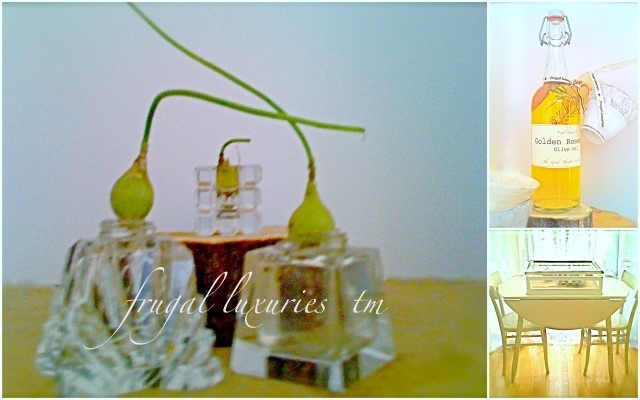
A Simple... Green... Way to Grow Windowsill Chives.


You might want to think twice before discarding those sprouted onions...


...and pretty pieces of broken stemware.


I save the sprouted onions and snip their green stems (i.e., chives) to use in recipes

such as soups & salads or as a garnish.

A spritz or two of water is all we need to keep them green.

We nestled the onion bulb (on the right) inside a wineglass with a broken stem...

then added a bit of moss (for looks :).


The onion bulb on the right... we set it inside a small iron garden urn!


Oh...notice...yet another way to use the broken wine glass is...


to turn it into a bell jar (as we did in the photo above, on the right).


Frugality...Function...Charm & Whimsy...

all rolled into one little project.

-------

Thursday, May 28, 2009

THE SIMPLE DOLLAR & Ten Grocery Products Be Ware Of...

The Simple Dollar website is one of my regular reads.
I appreciate their thorough research and straight forward writing.

Today's post reminded me that being a creature of habit is often expensive.
Below, you'll find a snippet of their post regarding bulk-pricing-surcharges.
Something to think about next time you're shopping at your local warehouse store!

=====

Grocery Shopping 101:

Quantity Surcharges and 10 Products to Watch Out For

Excerpted from The Simple Dollar.

"One common trap with buying in bulk is the fact that on some products, the higher volume version often has a higher cost per unit than the smaller version. For example, I recently spied two cans of tuna on the shelf at my local grocery store. The same brand (Starkist) featured a 5 ounce can for $1.29 and a 12 ounce can for $3.19. Per ounce, the smaller can featured tuna for $0.258 per ounce, while the larger can cost $0.265 per ounce, making the smaller can the better deal. This stuck in my head, so I went home and did some research on these price differences..."

Finish reading this informative article at The Simple Dollar
Publish Post

Friday, May 22, 2009

WIN THIS BOOK! Frugal Luxuries: Simple Pleasures to Enhance Your Life & Comfort Your Soul!

How?

Simply share one of your favorite frugal luxury or luxuries...

by clicking...

HERE !

Wednesday, April 29, 2009

Can Conserves and Consumption Be Friends???

FRUIT CONSERVES

...in...


FIFTEEN MINUTES OR LESS!

---

This morning I was looking at the last of the wondrously sweet and tasty strawberries

we bought in San Diego last weekend...


Lamenting the fact that they were all just a tad on the over-ripe side...

when it occurred to me to make a sugar-free conserve/jam...

for the refrigerator.

So....

I washed and sliced the strawberries directly into a saucepan....

added a squirt of lemon juice; a teaspoon of Splenda; and a teaspoon of

Xylitol (a natural sweetener from the natural foods store, but you don't need it for this recipe) ...

and about a cup of water...

brought them to a low boil and then decided to add...


...a cup of fresh/frozen cranberries along with teaspoon or two of

0range zest (and I squeezed a bit of the juice into it as well).


I cooked them at a high simmer for about ten minutes...

keeping a sharp eye on it while I brewed a nice pot of tea.


Once the cranberries popped (see photo above) I turned off the heat...


...and poured them into this French jam jar/glass and allowed them to cool.


I cut a double round of waxed paper and tied it atop the jar...


...and stored it in the refrigerator.

It tastes deliciously tart and surprisingly sweet!!

I'll use it to flavor plain yogurt and/or cottage cheese or use it as a topping for toast,
in lieu of jelly or jam.
-----

Wednesday, April 22, 2009

At Long Last...a Winner Has Been Revealed!!


--Emily Dickenson, referring to books.

Tuesday, April 7, 2009

We're Giving Away "FRUGAL LUXURIES BY THE SEASONS" Book!


In honor of the season of Spring, we are giving away a book...

Frugal Luxuries by the Seasons!

Click HERE to enter…

Friday, April 3, 2009

WHO... WILL BRING HOME THE VINTAGE GARDEN URN? FIND OUT NOW...

"Verily great grace may go with a little gift"
--Theocritus


-------

WHO... WILL BRING HOME THIS VINTAGE GARDEN URN?

To discover the answer...CLICK HERE
-------